

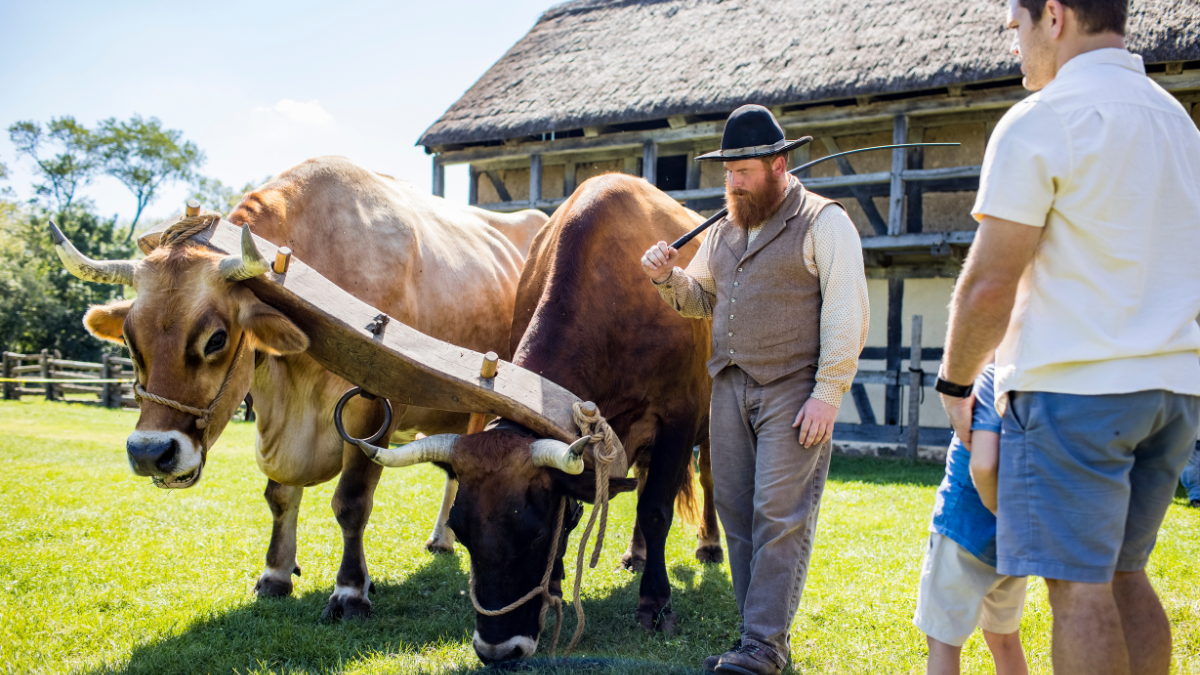
By Shelby Deering | Photo courtesy of Wisconsin Historical Society; pictured: Old World Wisconsin
With roots that date back thousands of years, first through Native American tribes who settled the land and then through explorers who arrived in the 17th century, Wisconsin has a storied history. It became a state in 1848, and went on to be well-known for its lumber and dairy industries. Many intrepid people formed Wisconsin into what it is today, and you can step into their homes, villages and lives through statewide historic destinations that will feel as if you traveled back in time.
BYGONE VILLAGES
Old World Wisconsin
When you think about Wisconsin history, Eagle’s Old World Wisconsin may immediately come to mind. With a focus on the 19th and early 20th-century farmers and rural residents who shaped Wisconsin’s background, this 600-acre locale includes a village and eight working farmsteads where you can see the state’s agricultural history unfold before your eyes.
The kids will also enjoy trying their hand at back-in-the-day, hands-on crafts, visiting with the animals and ambling along through the property’s heirloom gardens. You and a group of friends will love checking out the new outdoor Biergarten that just opened last May and celebrates Wisconsin’s extensive brewing history. See beer being made in real time at The Brewhouse and order a pint at Wittnebel’s Tavern, where bartenders in Depression-era garb will serve you.
Stonefield Historic Site
Another rural farming village to visit is Cassville’s Stonefield, a realistic hamlet set back in the 1900s that also includes the former Gothic Revival home of Wisconsin’s first governor, Nelson Dewey. The Stonefield Visitor Center also happens to be Governor Dewey’s horse stable. This is also where you’ll find the State Agricultural Museum, Wisconsin’s biggest collection of farm tools, models and machinery. The area is also known for its vibrantly-hued fall colors, so be sure to plan an autumn trip.
Heritage Hill State Historical Park
Although Green Bay is often most associated with our beloved Packers, it’s also where you’ll discover Heritage Hill State Historical Park. Situated on over 50 acres, you can explore 26 original and reconstructed buildings that
center on the history of Northeastern Wisconsin, from the 1600s to present day. Observe the blacksmith at work, take in the scents of food cooking in vintage kitchens and watch demonstrations and storytelling by costumed interpreters. For a current-day attraction, don’t miss the completely accessible, recently-built playground the kiddos are sure to love.
Madeline Island Museum
Residing in Lake Superior among Wisconsin’s famous Apostle Islands, you’ll find Madeline Island and its accompanying Madeline Island Museum. Here is where you’ll learn the history of this beautiful island, where you’ll view a grouping of historic buildings (constructed with rough-hewn logs that will transport you to the olden days) and don’t miss the Capser Center Gallery, a place where you can take in special exhibits, watch historical films, attend lectures and even participate in workshops. One of the top things you need to see? A 500-year-old dugout canoe that was discovered amid the Apostle Islands, on display at the museum.
Pioneer Village Museum
Located in Cameron, near Rice Lake, there’s the Pioneer Village Museum. Just as its name implies, it’s an entire village made up of all the things you would expect of an old Wisconsin town: a church, a one-room schoolhouse, a blacksmith shop, a train depot and even a jail and saloon. It’s made complete with old-fashioned log cabins, too. Historic treasures abound at the exhibition hall, from classic farm equipment to antique wedding dresses.
HISTORIC BUILDINGS
Villa Louis
In Prairie du Chien, there’s the National Historic Landmark Villa Louis, a stunning Victorian mansion. Owned by frontier entrepreneur Hercules Dousman, the fully-restored estate now looks exactly as it did back in the 1890s, with details inspired by the designer William Morris.
It’s also outfitted in plenty of period decor — in fact, nearly 90% of the collection on exhibit was originally owned by the Dousman family. The 25-acre historic site is punctuated with additional history through its dozen historic structures and the state’s only 1812 battlefield.
Wade House
In Sheboygan County’s Greenbush, the Wade House is a real-deal 1850s stagecoach inn that saw all sorts of people traveling through Wisconsin back in the day. But the history isn’t limited to the still-standing inn — you can also explore the blacksmith shop, sawmill and exhibits at the 20,000 square-foot Wesley W. Jung Carriage Museum & Visitor Center (think: working wagons, antique carriages that are right at home alongside the stagecoach inn — there’s even a carriage that was used by none other than Frank Lloyd Wright).
First Capitol Historic Site
Many Wisconsinites believe that the grand Wisconsin Capitol found in Madison has been the state’s one and only capitol building, but this isn’t the case. Actually, there was a “First Capitol,” located in Belmont, just outside of Platteville. This is where the first territorial legislature originally set up shop, before Wisconsin officially became a state, in 1836. During their time in these two humble white buildings, 42 laws were put on the books, and Madison was named as the capital city.
Here, you’ll also find an archeology exhibit, filled with items found in digs that were once used by people on the site.
CULTURAL LEGACY
Reed School
On the way to Eau Claire, be sure to make a stop at Neillsville’s Reed School. If you’ve ever wondered what it might be like to be a student learning in a one-room schoolhouse, Reed School is sure to provide a taste of that experience. Reed School was built in 1915, and joins the ranks of the 6,000 one-room schools that once populated Wisconsin.
You’ll enjoy the charming displays of antique school supplies, rows of old-school desks and audio and visual displays that tell the stories of past students.
H.H. Bennett Studio
If you love Wisconsin Dells and its picturesque sights, you should definitely visit downtown’s H.H. Bennett Studio. This is where you can fully immerse yourself in the area’s celebrated history, all told through the lens of famed photographer H.H. Bennett. Focusing on the beautiful landscapes, early travelers and rock formations of the Dells, Henry Hamilton Bennett opened his first studio in the area in 1875, and today it’s actually the oldest currently-operating business in the Dells. See time stand still in his original studio, view educational exhibits and, of course, see his stunning black-and-white photos of the Dells in all their glory.
Copper Culture State Park
Nestled right alongside Lake Michigan, there’s Oconto’s Copper Culture State Park, a 42-acre property that was the site of a prehistoric cemetery of the “Old Copper Complex” people, who lived in the northern Midwest from 4,000 to 2,000 B.C.E. Take a walk throughout the park and along the Oconto River and tour the museum that’s filled with relevant artifacts.
Menominee Logging Camp Museum
Travel to Keshena located within the Menominee Indian Reservation to visit the Menominee Logging Camp Museum, the largest and most complete logging museum in the United States. Logging is part of the state’s rich history, and here it comes alive with the help of artifacts, a bunkhouse (one of seven log buildings on the property), a blacksmith shop and more. Nearby there’s also the Menominee Indian Tribe’s Cultural Museum, a 6,000 square-foot building devoted to tribal artifacts, and group tours are available by appointment.


Comments are closed.